See it in Practice: To see these theories applied to a production-realistic architecture — including zero-allocation byte scanning, off-heap ring buffers, and SBE integration — review the complete source code for the Crypto Market Data Gateway on GitHub: rueishi/crypto-market-data-gateway
For most of Java’s history, enterprise engineering has revolved around a sensible bargain: optimize for developer productivity, maintainability, and functional correctness, and let modern hardware absorb the inefficiency. That bargain produced an enormously successful ecosystem. Frameworks such as Spring Boot, Hibernate, Jackson, and countless supporting libraries allowed teams to deliver features quickly, hire broadly, and manage complexity through layers of abstraction. In many domains, this is still the correct engineering decision.
But some systems do not live in that world.
In financial infrastructure, especially as markets move toward T+1 and eventually T+0 settlement, the meaning of “acceptable latency” changes fundamentally. The cost of delay is no longer a matter of user experience alone. It becomes a matter of capital exposure, operational risk, and market integrity. A pause of a few milliseconds may be irrelevant in an internal admin dashboard. The same pause inside a market-data gateway, a risk recalculation engine, or a margin system during a volatile event can be the difference between a contained incident and a cascading failure.
That is why low-latency engineering must be understood not as a niche obsession of high-frequency trading firms, but as a broader discipline of building deterministic software under real-time constraints. The point is not that every Java system should become an HFT engine. The point is that some systems now sit close enough to financial truth that performance is no longer a secondary property. It is part of the correctness model.
This article is about that shift. It is about what senior Java engineers must unlearn from standard enterprise practice, what they must learn from mechanical sympathy and deterministic design, and how AI changes the role of the engineer rather than diminishing it. It is also about a concrete architecture: a low-latency crypto market-data gateway built with Netty, Agrona, and Simple Binary Encoding, not as an academic toy, but as an example of how these ideas translate into system design.
The central claim is simple: in the T+0 era, the most important software systems are not merely those that produce the right answer, but those that produce the right answer with bounded and predictable latency under stress.
The Enterprise Model Works — Until It Doesn’t
Most enterprise Java systems are built on abstractions that deliberately hide machine-level detail. Objects are cheap to create. Frameworks map data automatically. Databases abstract persistence. JSON libraries abstract parsing. Thread pools abstract concurrency. Microservices abstract deployment boundaries. Garbage collection abstracts memory management.
That stack makes perfect sense for the majority of business applications. If a service can respond in tens of milliseconds and occasionally in hundreds, the business is often still healthy. If a cloud bill rises because the team chose a more abstract framework, that may still be a rational trade if the gain in velocity outweighs the cost in hardware. In these environments, engineering is correctly optimized for delivery speed, code readability, and organizational scale.
The danger begins when engineers bring the same assumptions into domains where latency variability is itself a failure mode.
The problem is not that enterprise frameworks are “bad.” The problem is that they optimize for a different objective function. They make common tasks easier by introducing indirection, metadata processing, reflection, allocation, runtime dispatch, and cross-layer abstraction. In most systems, that overhead is acceptable. In deterministic systems, it is often fatal.
What makes this deceptive is that such systems may perform perfectly well under normal conditions. Standard load tests may show healthy CPU, modest memory usage, and strong average throughput. Dashboards may remain green. Everything may seem overprovisioned.
Then production deviates from the happy path.
A downstream service stalls. A network partition occurs. Exchange connectivity drops for twenty minutes. A recovery replay begins in a volatile market. Messages arrive not at steady-state rates but in violent bursts. The software is no longer evaluated by how gracefully it handles ordinary load. It is evaluated by how it behaves in a storm.
That is where determinism matters.
The GC Death Spiral: When Throughput Thinking Fails
One of the defining production failure modes in Java latency-sensitive systems is not a crash, but a loss of timing guarantees. The system continues to run, but it cannot keep pace with reality.
The mechanism is usually straightforward.
A framework-heavy system processing high-volume messages allocates temporary objects constantly. JSON parsing creates tokens, nodes, strings, or binding-layer objects. ORM layers create proxy objects, entities, and persistence-context state. Collections expand. Logging frameworks allocate message buffers. Metrics and tracing add more overhead. Under normal load, the garbage collector may keep up comfortably.
But a backlog event changes the arithmetic. Suppose a downstream network link is unavailable for thirty minutes during an active market. Messages accumulate. When connectivity returns, the system attempts to process a backlog that may be ten or twenty times normal volume. Allocation rate increases sharply. The collector now faces a moving target. The JVM pauses to reclaim memory. During the pause, inbound queues continue to fill. When the application resumes, it processes a larger backlog and allocates even faster. GC cycles become more frequent or longer. Latency balloons. Operators see “mysterious delays” while dashboards fail to identify a single crashing component.
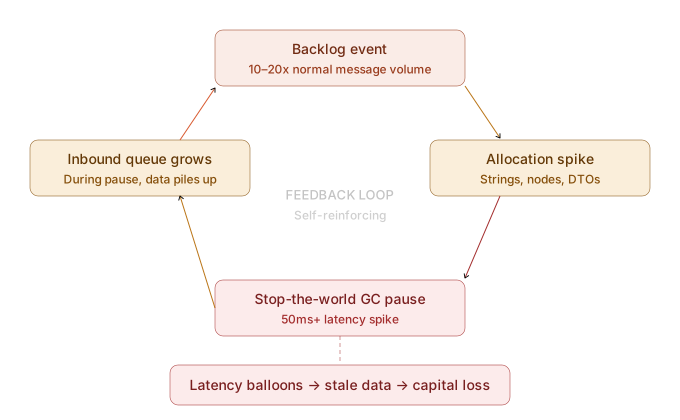
This is what many teams eventually learn to fear: not simple GC overhead, but the feedback loop where allocation pressure and backlog growth reinforce each other. A system designed around average throughput can fail catastrophically when exposed to burst recovery, because average throughput is not the relevant metric. The real metric is sustained processing capacity under worst-case allocation pressure without violating latency bounds.
That is why low-latency engineering frequently begins with a seemingly extreme rule: in the hot path, allocation is not merely undesirable; it is a design defect unless proven necessary.
This does not mean the entire application must be allocation-free. Configuration code, startup logic, admin endpoints, test harnesses, and control-plane workflows can allocate freely. The discipline applies to the throughput-critical, latency-sensitive execution path. The trick is to know exactly where that path begins and ends.
The Multi-Threading Trap and the Single-Writer Principle
The second major misconception inherited from mainstream backend engineering is that more threads automatically create more performance.
In general server development, this is often a sensible instinct. If one resource blocks, additional threads can keep the system busy. If work is independent, parallelism can improve throughput. Java has excellent concurrency primitives, and modern CPUs have many cores. Why not use them all?
Because latency-sensitive systems are rarely limited only by raw compute. They are limited by coordination cost, cache behavior, memory visibility, contention, and scheduling jitter. Each additional thread interacting with shared mutable state introduces complexity that manifests physically in the machine. Locks cause contention. Volatile writes create barriers. Shared cache lines trigger coherence traffic. Context switching destroys locality. Thread migration warms and cools caches unpredictably.
At sufficient scale, “add more threads” becomes a way of adding more latency variance.
This is why many of the fastest Java systems converge on the single-writer principle. One thread owns a piece of mutable state. That thread performs all state mutation for that partition of work. Other threads may hand off data or receive outputs, but they do not contend for ownership of the same live structure.
The idea sounds simple, even obvious, yet it is deeply countercultural to standard enterprise design. It rejects the instinct to make everything concurrently accessible and instead treats ownership as a first-class performance primitive.
Consider an order book, a position ledger, or a venue session state machine. In a low-latency design, one thread often owns updates for that state. There is no lock protecting it because there is no competing writer. The benefit is not just lower average latency. It is lower unpredictability. Once the machine no longer has to arbitrate between multiple writers, the software becomes easier to reason about, easier to benchmark, and less vulnerable to pathological slowdowns.
The single-writer principle is not a dogma to be applied everywhere. It is a way of aligning software design with what CPUs actually do well: sequential, cache-friendly mutation by a stable owner.
Amdahl’s Law Is Not Academic — It Is Operational Reality
A common failure of optimization work is to focus intensely on a local hot path while ignoring the system boundary immediately downstream.
An engineer may build a custom parser that converts exchange messages in a few microseconds. They may use off-heap buffers, avoid allocation, pin threads, and benchmark beautifully. But if the result of that parser is then synchronously handed to a database call, a REST request, a heavyweight serialization layer, or a multi-hop service mesh path that takes tens of milliseconds, the total architecture is still slow.
This is not just Amdahl’s Law in a textbook sense. It is an architectural warning. Every fast component upstream of a slow synchronous bottleneck becomes a pressure generator. The faster you ingest, the faster you drown the chokepoint. Eventually the system must either batch, shed load, decouple, or fail.
That is why deterministic systems require more than a fast parser. They require explicit control of the full critical path. If the ingress side operates at microsecond latency but the handoff model assumes millisecond-class synchronous processing, the architecture is incoherent.
This is also why low-latency systems favor binary protocols, shared memory, lock-free ring buffers, or append-only logs for communication between stages. These mechanisms keep boundaries lightweight and predictable. The goal is not merely “fast code” but bounded end-to-end behavior.
Distribution Is Powerful, but Every Boundary Has a Cost
Modern engineering culture often treats distributed architecture as the natural destination of serious systems. Once scale appears, the presumed answer is more services, more shards, more queues, more network boundaries, more orchestrated infrastructure.
There are good reasons for this. Distribution helps with organizational ownership, fault isolation, horizontal scale, deployment independence, and regional redundancy. For many applications, these benefits dominate.
But network boundaries are not free. A distributed system does not eliminate latency; it moves latency into serialization, queuing, TCP behavior, kernel scheduling, retransmission, TLS, coordination, consensus, and observability overhead. Even when average latency appears tolerable, tail behavior often worsens dramatically.
For low-latency financial software, this matters because the system must often make decisions on live market or risk state, not on eventually propagated copies of that state. Unnecessary distribution introduces not only delay but temporal uncertainty. The question ceases to be “Did we receive the right data?” and becomes “Did we receive the right data before we needed to act on it?”
A more disciplined principle is this: distribute when there is a clear business or resilience reason to distribute, not as a default scaling reflex. If a single node can process the required throughput with clean failover to a hot standby, then adding fifty nodes may be architectural theater rather than engineering.
That does not mean single-node systems are universally superior. It means low-latency architecture begins by clearing system boundaries aggressively and only then reintroducing distribution deliberately.
Why AI Makes Senior Engineers More Important, Not Less
The arrival of AI-assisted software development has changed how engineers produce code, but it has not changed the physics of a CPU, the behavior of a cache hierarchy, or the consequences of poorly bounded latency.
AI is excellent at generating functional implementations. It can scaffold services, produce integration code, create tests, suggest refactors, and accelerate routine development. It is especially strong when the target architecture matches the dominant patterns in public code and documentation. That usually means frameworks, object models, standard libraries, and service-oriented conventions.
What AI does not automatically do is optimize for hidden machine-level constraints unless those constraints are explicitly stated and repeatedly enforced. Left unguided, it tends to generate correct, maintainable, familiar code, not cache-aware, allocation-constrained, tail-latency-safe code. It will often prefer a DTO where a flyweight would suffice, a map where an indexed structure would be more predictable, a general parser where a one-pass scanner is needed, or an asynchronous multi-service design where a single in-process pipeline would be faster and safer.
This is not a criticism of AI. It reflects its training incentives. The default goal is usually code that works and resembles accepted practice. In the majority of software engineering, that is desirable. But in low-latency design, accepted practice is frequently the wrong local optimum.
That is why the role of the senior engineer becomes more important in the AI era. The senior engineer must define the constraints that AI will not invent on its own. They must know where allocation is forbidden, where ownership must be singular, where distribution must be resisted, where binary wire formats are justified, where cache friendliness matters, and where mechanical sympathy outweighs convenience.
AI can help build the system. Senior engineers must still define the performance truth the system is required to obey.
A good way to state it is this: AI can generate software that functions; senior engineers must ensure the software remains deterministic when the world stops being polite.
A Concrete Case Study: The Deterministic Market-Data Gateway
To make these principles tangible, consider a crypto market-data gateway. Its job is simple to describe: connect to exchange feeds such as Coinbase, Binance, or Kraken; receive level-two order book updates; normalize them into an internal binary message format; and publish them to downstream components such as order books, analytics engines, or risk systems.
If you build this using standard enterprise tools, it will work perfectly during a quiet Tuesday afternoon. But crypto markets do not have closing bells, and they do not respect “average throughput.” When a major asset drops 5% in three minutes, the exchange does not politely throttle its data. It blasts hundreds of thousands of updates down the WebSocket in violent, concentrated bursts.
If your gateway is built on an enterprise stack, this burst triggers a massive allocation of temporary strings, JSON nodes, and domain objects. The Garbage Collector is overwhelmed, and the JVM initiates a stop-the-world pause that lasts 50 milliseconds.
In that 50 milliseconds, the actual market price has moved entirely. But your downstream trading algorithm doesn’t know that. It executes a trade based on a ghost of the order book. By the time the gateway wakes up and flushes the backlog, the firm has suffered an immediate, unrecoverable capital loss.
This is why zero-allocation and determinism are a strict mandate, not a preference. The gateway cannot dictate the pace of the market, so it must guarantee that its processing time remains absolutely flat. A production-realistic low-latency design prevents the GC Death Spiral by enforcing four strict architectural rules:
First, venue isolation matters. A single process per exchange prevents one exchange’s surge or outage from starving another’s compute budget. The system becomes easier to benchmark, easier to reason about, and easier to recover.
Second, connection topology must avoid head-of-line blocking. Multiplexing many instruments over a single channel is dangerous. Dedicating one connection per instrument or a tightly bounded group offers better isolation. If the Ethereum stream becomes noisy, the Bitcoin stream remains completely isolated.
Third, event-loop ownership must be explicit. The thread handling network ingress exclusively owns its buffers and parsing state. If handoff is required, it is done through a bounded, non-blocking publication mechanism (like an Agrona ring buffer) rather than an unbounded queue or a blocking downstream call.
Fourth, the normalization step must avoid Java object graphs. A market-data update should not become a heap of strings, lists, nodes, and wrapper objects. A custom scanner translates raw network bytes directly into primitive, fixed-scale integers, and writes them straight to an SBE binary publication buffer.
This is the kind of system where low-latency Java shines when used with discipline.
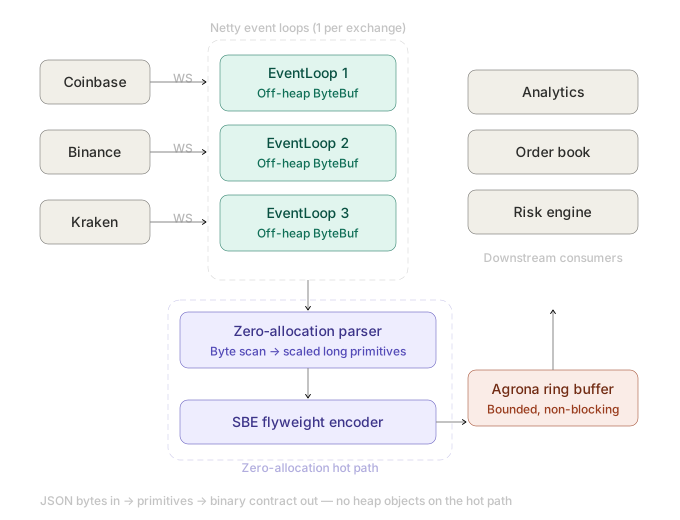
Crypto Market Data Gateway Architecture
The Stack: Netty, Agrona, and SBE
A practical implementation often uses a small set of libraries with very specific roles.
Netty provides the networking layer. Its direct buffers allow payloads to arrive off-heap, which avoids copying into ordinary heap arrays unnecessarily. On Linux, native transports such as epoll reduce some of the overhead of pure JDK networking and give the engineer more control over event-loop behavior.
Agrona provides fundamental concurrency and memory tools. Its direct buffers, ring-buffer implementations, and low-level utilities are designed for precisely the style of software that cares about object avoidance, explicit ownership, and predictable communication between components.
Simple Binary Encoding, or SBE, provides the wire contract for normalized messages. Instead of serializing object graphs into general-purpose formats, the system writes primitive fields directly into a known binary layout. Encoders and decoders are generated ahead of time and act as flyweights over a memory buffer. There is no reflective serialization step, no schema discovery at runtime, and no need for intermediary data structures if the program is designed cleanly.
Each of these tools does one thing well. More importantly, they encourage a style of programming in which the engineer remains close to the data representation and close to the hardware implications of their code.
The Parsing Problem: Where Determinism Is Won or Lost
Most exchange market-data feeds, especially in crypto, arrive as JSON over WebSocket. JSON is human-readable and operationally convenient, but it is hostile to deterministic, high-throughput processing if handled with standard object-mapping libraries.
A typical JSON stack takes raw bytes, tokenizes them, allocates parser state, creates field names and values, produces object nodes or binds into DTOs, possibly converts strings to numbers, and only then gives the application the values it actually cares about. This is ergonomic. It is also exactly the wrong shape for a hot path receiving vast numbers of small updates.
A deterministic parser does less.
It treats the payload as bytes, not as “JSON objects.” It scans once, looking only for the fields relevant to the specific message type. It avoids copying unless necessary. It parses numeric fields directly into primitive integers or fixed-scale longs. It never constructs a string unless a human operator genuinely needs one.
Consider a simplified price parser in Java:
public final class DecimalAsciiParser {
    private DecimalAsciiParser() {}

    /**
     * Parses ASCII decimal bytes like "12345.67" into fixed-scale long 1234567
     * when scale = 2. Assumes valid input and no exponent notation.
     */
    public static long parseFixedPoint(byte[] buffer, int offset, int length, int scale) {
        long value = 0L;
        boolean negative = false;
        int fractionalDigits = 0;
        boolean pastDot = false;

        int i = offset;
        int end = offset + length;

        if (buffer[i] == '-') {
            negative = true;
            i++;
        }

        while (i < end) {
            byte b = buffer[i++];
            if (b == '.') {
                pastDot = true;
                continue;
            }

            value = (value * 10L) + (b - '0');

            if (pastDot) {
                fractionalDigits++;
            }
        }

        while (fractionalDigits < scale) {
            value *= 10L;
            fractionalDigits++;
        }

        return negative ? -value : value;
    }
}
Note: This snippet assumes upstream validation or network-level sanitization for brevity. A production implementation requires aggressive bounds checking and digit validation, but the core zero-allocation loop remains exactly the same.
Parsing the number, however, is only half the battle; the other half is knowing what to ignore. In JSON or FIX, up to 80% of the payload might be metadata you don’t care about (e.g., exchange sequence numbers, matching engine IDs, original order IDs). If you parse them, you waste CPU cycles.
A production gateway relies on a MessageScanner — a tight state machine that rapidly scans the buffer, skipping over irrelevant keys and jumping directly to the payload fields. It does not parse the whole tree; it acts as a router, advancing a read-pointer and dispatching directly to specialized routines (like the DecimalAsciiParser) the moment a relevant byte sequence is detected. That kind of code is less general than a library parser, but that loss of generality is exactly the source of performance.
The challenge is not writing such code once. The challenge is recognizing when the business case is strong enough to justify it.
Primitive-First Data Modeling: The Zero-Allocation Design Philosophy
A recurring mistake in financial programming is to treat data representation as a secondary concern — something to be decided by convenience, framework convention, or the natural mapping of domain concepts to Java objects. In deterministic hot-path design, data representation is a primary architectural decision, because every object you create is a liability: a GC obligation, a cache miss waiting to happen, and a source of allocation pressure that compounds under burst conditions.
The entry point to this philosophy is the double, and why it is a design smell in any financial hot path.
Binary floating-point cannot represent many decimal fractions exactly. Values that appear obvious in decimal are approximated in binary. Over large numbers of operations — price accumulations, PnL calculations, margin checks — these approximations can diverge subtly across systems, languages, and even JVM restarts. In a system where correctness depends on exact matching of prices, sizes, and balances, this is not a minor inconvenience. It is a silent correctness failure.
The standard replacement is well known: represent decimal quantities as scaled long values. A price of 123.45 becomes 12345L with a declared scale of two. The parser knows the scale. The encoder knows the scale. The consumer knows the scale. Arithmetic becomes integer arithmetic. Precision becomes explicit and stable. The representation is not only safer — it is faster, because integer operations on primitives are cheaper than floating-point operations on boxed objects, and the JIT compiler has far more room to optimize predictable integer arithmetic than it does general floating-point code.
But double is only the entry point. The deeper principle is this: in a deterministic hot path, your entire data model should be expressible in primitives.
Identifiers: UUID as Two Longs
Consider the L3 order book — the data structure that tracks every individual resting order on a venue, each identified by a unique order ID. At peak load on a liquid instrument, hundreds of thousands of add, modify, and cancel events arrive per second. Every one of those events references an order by UUID.
The naive Java implementation reaches for UUID objects and a HashMap<UUID, Order>. That choice looks natural. It is also a systematic failure mode.
Every lookup allocates a UUID object. The HashMap boxes keys, maintains collision chains, and scatters Order objects across the heap. Every cache miss fetches an Order from a memory address unrelated to the previous one. Under a burst event — fifty thousand order cancellations arriving in two milliseconds — transient UUID allocations spike the allocation rate, GC pressure builds, and the book risks losing consistency during a stop-the-world pause at precisely the moment market state is changing fastest.
The primitive-first solution recognizes that a UUID is just 128 bits of identity. It does not need to be an object. Represent it as two long fields: highBits and lowBits. No allocation. No object header. No reference indirection. The UUID travels through the entire hot path as two primitives, from wire bytes to book update, without ever being materialized as a heap object.
// UUID arrives on the wire as two 8-byte sequences
long highBits = buffer.getLong(offset);
long lowBits  = buffer.getLong(offset + 8);
// No UUID object. Ever.
Lookups: Int Hash Index into a Pre-Allocated Array
Eliminating the UUID object solves the allocation problem, but the HashMap itself remains. Even with primitive keys, a general-purpose hash map brings object overhead, load-factor management, resize events, and non-sequential memory access patterns that are hostile to the CPU prefetcher.
The replacement is a pre-allocated array of fixed-size order slots, addressed by an int hash index derived from the two long identity fields.
public final class OrderIndex {
    private static final int CAPACITY = 1 << 17; // 131072 slots, must be power of 2
    private static final int MASK = CAPACITY - 1;

    // Parallel arrays: one slot per order, laid out contiguously in memory
    private final long[] highBits  = new long[CAPACITY];
    private final long[] lowBits   = new long[CAPACITY];
    private final long[] price     = new long[CAPACITY];
    private final long[] quantity  = new long[CAPACITY];
    private final int[]  side      = new int[CAPACITY];

    private static int slot(long high, long low) {
        long h = high ^ (high >>> 32) ^ low ^ (low >>> 32);
        return (int)(h ^ (h >>> 16)) & MASK;
    }

    public void insert(long high, long low, long px, long qty, int sd) {
        int i = slot(high, low);
        // Open addressing: linear probe for empty slot
        while (highBits[i] != 0 || lowBits[i] != 0) {
            i = (i + 1) & MASK;
        }
        highBits[i] = high; lowBits[i] = low;
        price[i]    = px;   quantity[i] = qty;
        side[i]     = sd;
    }

    public int find(long high, long low) {
        int i = slot(high, low);
        while (highBits[i] != 0 || lowBits[i] != 0) {
            if (highBits[i] == high && lowBits[i] == low) return i;
            i = (i + 1) & MASK;
        }
        return -1;
    }
}
This structure achieves what might be called zero-allocation map behavior. Add, lookup, and cancel are array index operations. There are no intermediate objects. There are no boxed keys. There are no resize events once the structure is pre-allocated at startup. The data lives in contiguous arrays that the CPU prefetcher can stream efficiently, rather than scattered across a heap of individually allocated Order objects.
The capacity must be sized conservatively for the maximum expected open-order count per instrument or venue session, with headroom for probe chains. That is a known, bounded quantity in any well-specified trading system.
The Full Zero-Allocation Pipeline
The true power of this approach becomes visible when you trace a single order event from wire to book state:
- Wire bytes arrive in a Netty off-heap buffer — no heap copy
- UUID parsed directly as
highBitsandlowBits— noUUIDobject - Price parsed by
DecimalAsciiParserinto a scaledlong— nodouble, noBigDecimal - Array slot located by
inthash index — noHashMap, no allocation - Order state mutated in-place in the parallel arrays — no object creation
- SBE encoder writes primitives directly into a publication buffer — no object graph serialization
At no point in that pipeline does the hot path create a heap object. The GC has nothing to collect. The caches behave predictably because the working set is a small number of contiguous arrays rather than a constellation of scattered heap objects. The system does not merely run faster — it runs calmly, with flat, predictable latency even as event rates spike.
This is the essence of primitive-first data modeling. It is not a collection of micro-optimizations. It is a coherent design philosophy: represent domain state as the machine already wants to see it, and let the business semantics live at the protocol boundary where they belong, not in the heap objects that process them.
double is where the conversation starts. Zero-allocation pipelines are where it ends.
Zero-Serialization Publishing: From Wire Bytes to Binary Contracts
Once the gateway has extracted primitive values from the incoming payload, the next question is how to hand them off.
The naive path is familiar. Parse JSON into a DTO, transform DTO into an internal object model, serialize the object model into another format, and send it onward. That architecture is flexible, but it is full of transient heap traffic.
The low-latency path is different. The parser writes directly into a binary publication buffer using a fixed schema.
A simplified example using an Agrona-style buffer might look like this:
public final class BookUpdateEncoder {
    public static final int BLOCK_LENGTH = 32;

    public static void encode(
            org.agrona.MutableDirectBuffer buffer,
            int offset,
            long instrumentId,
            long price,
            long quantity,
            long eventTimeNanos) {

        int pos = offset;
        buffer.putLong(pos, instrumentId);  pos += 8;
        buffer.putLong(pos, price);         pos += 8;
        buffer.putLong(pos, quantity);      pos += 8;
        buffer.putLong(pos, eventTimeNanos);
    }
}
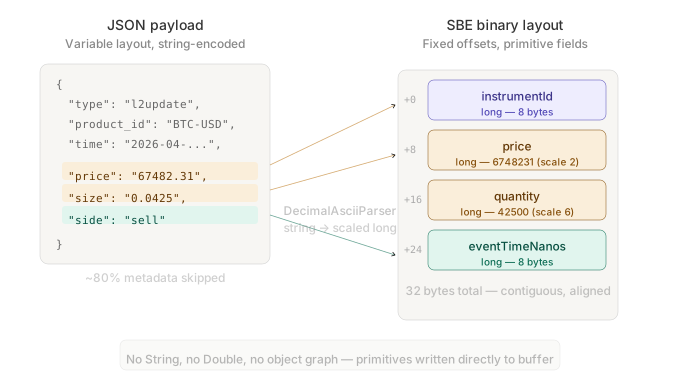
Diagram illustrating the transition from unstructured JSON payloads mapping directly into an aligned, packed SBE binary memory layout.
Real systems will usually use generated SBE flyweights rather than hand-written field offsets, because schema governance matters. But the essential idea is the same. The data is written once, in a contiguous buffer, in a predictable layout. Downstream consumers read it directly without any heavyweight serialization step in between.
The true power of the generated SBE flyweight is that it acts as a zero-cost abstraction. Because the generated encoders are concrete, final classes rather than polymorphic interfaces, there are no virtual method calls on the hot path. The JVM’s Just-In-Time (JIT) compiler aggressively devirtualizes and inlines these method calls, turning your Java code directly into native CPU instructions that write to contiguous memory.
This is where one sees the full architecture come together. Netty receives off-heap bytes. The parser scans them into primitives. SBE writes those primitives into a binary contract. An Agrona or Aeron publication sends them onward. At no point does the software need to assemble a rich heap object just to tear it down again for transport.
The result is not merely “fast.” It is calm. The machine does less work. The collector has less to do. The caches behave more predictably. The architecture stops fighting the hardware.
Benchmarks Matter, but They Must Be Honest
No rigorous discussion of low-latency design is complete without measurement. But measurement in this domain is notoriously easy to fake.
Average throughput is not enough. Median latency is not enough. A single fast benchmark on warm hardware with unrealistic input is not enough. The important numbers are usually tail latency, allocation rate, and behavior under burst or recovery conditions.
There is a dangerous culture in Java performance engineering that relies entirely on JMH (Java Microbenchmark Harness). JMH microbenchmarks are exceptional for proving that your ASCII parser or ring buffer is fast in isolation. But the moment you claim “our gateway latency is 2 microseconds,” a JMH score in an empty heap is meaningless.
That claim can only be validated by an end-to-end replay under load, accompanied by flat GC logs, hardware network metrics, and async-profiler flame graphs proving the absence of kernel or synchronization stalls. JMH proves your math is fast; end-to-end testing proves your architecture is sound.
A proper benchmarking regime should therefore include several kinds of tests:
- Microbenchmarks: Validate critical routines such as ASCII parsing or buffer encoding. These runs should include GC profiling and fail if supposed zero-allocation paths allocate any bytes at all.
- Deterministic end-to-end tests: Replay captured traffic through the full gateway pipeline, verifying not just speed but exact output correctness.
- Soak tests: Run tens of millions of messages to observe resident set size, native buffer behavior, and long-tail latency drift.
- Recovery tests: Simulate outages and backlogs, because that is where many systems lie about their capacity.
If the benchmark suite only shows a flat median under clean steady-state traffic, it is not telling the truth that production cares about.
Backpressure: The System Must Choose, Not Freeze
One of the most dangerous mistakes in a low-latency gateway is to let downstream slowness block the ingress thread.
If the event loop reading exchange traffic performs a blocking enqueue, a synchronous RPC, or any other wait on the downstream path, then backpressure turns into ingress paralysis. Market data piles up at the edge of the system precisely when it is most urgent.
This is why hot-path publication mechanisms are often designed to be non-blocking. A bounded ring buffer or publication channel will return a signal indicating success or backpressure. The ingress side must then have an explicit policy.
Sometimes the correct policy is to drop stale updates and trigger a recovery snapshot. In some order-book protocols, missing one delta means the local book is no longer trustworthy, so the safest response is to declare the stream dirty and resynchronize. In other cases, coalescing or overwriting newer state may be acceptable. The key point is that the policy must be explicit and domain-driven.
What must not happen is the silent default where the system “helpfully” waits and turns a brief downstream delay into a full upstream outage.
Deterministic systems cannot avoid hard choices. They simply make those choices visible.
Production Readiness Is a Different Discipline from Fast Code
It is possible to write a very fast piece of software that fails immediately in production because its operational design is naive.
Low-latency systems need a different kind of rigor in testing and deployment.
A deterministic market-data gateway should be tested against historical captures with known starting and ending states. If the replayed outputs do not reconstruct the exact final order book, the system is wrong, even if it is fast.
It should be soak-tested long enough to expose native memory leaks, off-heap fragmentation issues, and accumulation of supposedly temporary state.
Its instrumentation should include not just ordinary application metrics but also allocation tracking, GC pause visibility, and preferably profiling with tools such as async-profiler or perf to reveal cache misses, branch misprediction, or kernel time under load.
Its operational model should isolate venue-specific failures. A surge or disconnect in one exchange feed should not degrade others. Control-plane actions such as resubscription, reconnect, and snapshot recovery should be designed to avoid contaminating the hot path.
This is where senior engineers distinguish themselves. Low-latency engineering is not a trick for writing fast loops. It is a full-system discipline that assumes production will attack the edges of the design.
Beyond the JVM: Mechanical Sympathy and the Operating System
Once the application architecture is sound, further latency reduction increasingly depends on hardware and operating-system behavior. This is the realm often associated with mechanical sympathy: understanding how software interacts with CPU caches, memory buses, interrupts, and the scheduler.
CPU cache locality is the first principle. Modern processors are extraordinarily fast when data is already in L1 or L2 cache and painfully slow when they must fetch from main memory. Heap object graphs are often hostile to locality because object headers, references, and allocations scatter data spatially. Flat binary buffers, fixed layouts, and sequential access patterns are much friendlier to cache behavior and to hardware prefetchers.
Thread affinity is the next step. The Linux scheduler tries to balance system load fairly, but fairness is not the same as low jitter. If a hot thread is moved from one core to another, it loses warm caches and experiences latency spikes as the new core repopulates working data. Pinning a latency-critical thread to a dedicated core can reduce that variability dramatically.
Beyond that lies CPU isolation. Kernel boot parameters such as isolcpus can reserve specific cores from general scheduling so that background daemons, unrelated application threads, and even some JVM activity do not interfere with the hot path.
Power management is another hidden source of jitter. Modern processors enter deeper sleep states to conserve energy, but waking from those states incurs latency. In throughput systems this is often irrelevant. In market-facing systems it may be unacceptable. Tuning BIOS and kernel settings to keep trading cores in higher-performance states can reduce latency variance at the cost of power efficiency.
Interrupt affinity matters as well. If the network card’s interrupts land on the same core as the critical application thread, the kernel can preempt the application at precisely the wrong moment. Assigning IRQ processing to separate cores helps preserve isolation.
A critical caveat: these hardware-level tunings are designed for bare-metal servers or highly specialized cloud environments (like AWS EC2 Bare Metal instances or dedicated hosts). If you attempt to use
isolcpusor IRQ affinity on a standard, shared-tenancy cloud VM, the underlying hypervisor will still preempt your cores to manage ‘noisy neighbors.’ Hardware sympathy requires actual hardware control.
None of this tuning should be performed casually. It is workload-specific, environment-specific, and can make the system harder to operate. But at the bleeding edge, once the software architecture is clean, the remaining latency budget often lives in these details.
That is also why low-latency engineering is not just “Java engineering.” It is software, hardware, and operations meeting at the same boundary.
High Availability Without Destroying the Hot Path
One objection to low-latency single-node design is obvious: what about resilience?
If the system is genuinely business-critical, it cannot rely on one process on one machine surviving forever. But there is a difference between introducing resilience carefully and smearing the hot path across a distributed architecture that destroys determinism.
One powerful model is the replicated state machine. Systems such as Aeron Cluster use a log of ordered inputs replicated across several nodes. The business logic remains deterministic. Each node processes the same sequence of messages and arrives at the same state. Leadership and failover are handled by the cluster machinery, while the application logic remains a clean, deterministic state machine.
This is attractive because it separates consensus I/O from core business mutation. The hot-path logic does not need to become a patchwork of distributed coordination calls. It consumes an ordered log. If the leader fails, another node with the same state can take over.
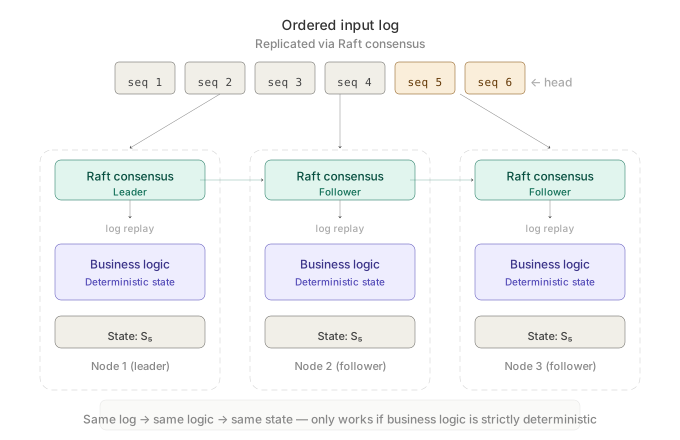
Raft consensus algorithm decoupling the I/O clustering log from the deterministic business logic
Crucially, this model only works if the business logic is strictly deterministic. If a system uses double for prices, or relies on System.currentTimeMillis(), the state machines will diverge, and consensus fails. This brings the entire architecture full circle: the zero-allocation, primitive-based parsing we discussed earlier is not just about speed — it is the absolute prerequisite for deterministic high availability. Resilience should preserve determinism where possible rather than undo it.
The Trade-Offs Are Real
It is important to be honest. Low-latency engineering has costs.
It is harder to write, harder to review, and harder to maintain. It demands engineers who understand not just Java semantics but memory behavior, CPU architecture, operating-system scheduling, and domain-specific failure models. It can reduce flexibility. Specialized parsers and binary contracts are less convenient than object mappers and self-describing payloads. Debugging byte-oriented code is less friendly than debugging richly typed heap objects. Hiring becomes narrower. Onboarding takes longer.
These are not trivial disadvantages. They are precisely why most systems should not be built this way.
A dashboard, an internal workflow system, a customer-facing CRUD service, a reporting engine, or a moderate-throughput event processor will usually benefit more from simplicity and maintainability than from microsecond-level determinism. It would be foolish to impose low-latency discipline indiscriminately.
The art is in knowing where the boundary lies.
When the system’s business value depends on reacting to reality before that reality changes, the trade-offs begin to shift. Market-data ingestion, execution pipelines, real-time risk checks, venue gateways, and certain classes of matching, clearing, or settlement infrastructure sit on that boundary. There, performance work is not premature optimization. It is the work of preserving business correctness in time.
The Real Shift: Performance as a First-Class Business Constraint
The most important conceptual change is not any single tool or technique. It is the recognition that latency-sensitive financial systems cannot be designed as ordinary enterprise applications with a few optimizations sprinkled on top.
They require a different starting point.
They begin with ownership boundaries, not shared mutability. They prefer explicit state machines to invisible framework flows. They treat allocation as a budgeted resource rather than an incidental byproduct. They choose binary representations where generic serialization would introduce churn. They benchmark worst-case behavior, not just the happy path. They understand that recovery scenarios are part of the mainline design, not an afterthought.
In that sense, low-latency engineering is not really about making Java “fast.” Java is already fast when used well. The deeper issue is making the system behavior physically plausible under the conditions the business actually faces.
That is what the move toward T+0 changes. It collapses the gap between software timing and financial truth. A system that computes the right risk five seconds too late is not merely slow. It is wrong in the only way that matters operationally.
Conclusion
Java is often discussed as though it exists on a spectrum between enterprise productivity and high-performance niche wizardry. That framing misses the more interesting reality. Java is one of the few ecosystems mature enough to support both extremes. It can power enormous framework-heavy business platforms, and it can also support carefully engineered deterministic systems that run frighteningly close to the hardware.
The challenge for modern engineers is knowing which mode they are in.
As AI accelerates routine development, this distinction becomes more important, not less. Boilerplate, scaffolding, and standard integration patterns will become increasingly automated. What will remain differentiating is the ability to define performance boundaries, understand machine costs, and align architecture with the temporal demands of the business.
That is the work of the senior engineer.
Not because senior engineers are the only people who can write specialized code, but because they must decide when such specialization is warranted, how far it should go, and where abstraction stops being a help and starts becoming a lie.
The future of critical financial infrastructure will not be won by the systems with the prettiest abstractions or the most fashionable architecture diagrams. It will be won by the systems that remain correct when the market stops cooperating, when the backlog surges, when the network stutters, and when every unnecessary microsecond compounds into real exposure.
In that world, low-latency Java is not a curiosity.
It is a discipline of engineering honesty.
Want the full working gateway implementation with zero-allocation parsing, SBE encoders, and Agrona ring buffers? Star the repo here: Crypto Market Data Gateway. Questions, war stories, or suggestions from your own low-latency battles? Drop them in the comments — I read every one.
Tags: Java, Low Latency, Fintech, Market Data, Deterministic Systems